
Date posted: 4th Sept 2026
A new Ibec report points to rising demand for industry-led workforce development, alongside clear evidence that Skillnet Business Network training is delivering practical value for Irish businesses.
Irish businesses are being asked to adapt at speed. AI, cybersecurity, automation and other forms of digital transformation are changing roles, skills requirements and the way organisations work.
Against that backdrop, Ibec’s new report, Building Stronger Businesses: The Skillnet Business Networks Effect, examines how the Skillnet Business Network model is helping companies develop the capabilities they need, and what will be required to meet growing demand in the years ahead.
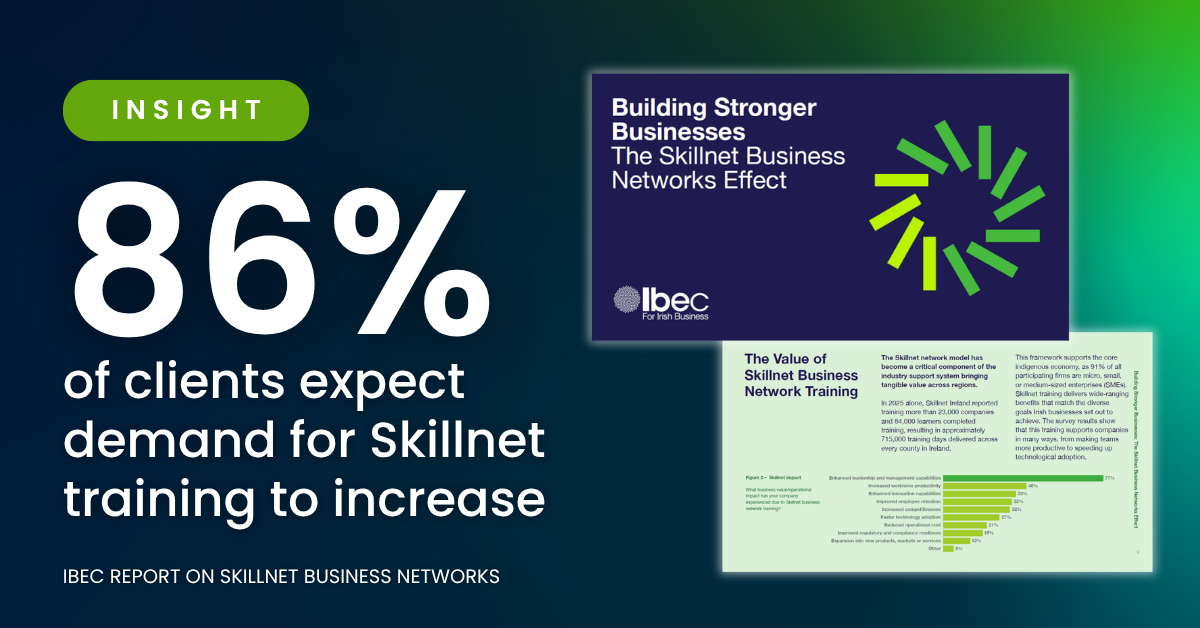
The report finds that 86% of surveyed businesses expect their demand for Skillnet Business Network training to increase over the next five years. Almost half, 46%, expect that increase to be significant.
For Technology Ireland ICT Skillnet, one of the 10x Skillnet Business Networks promoted by Ibec and celebrating our 20th year of industry led workforce development, these findings reflects a wider challenge facing the technology sector: skills needs are not standing still. Businesses increasingly need to develop existing teams as new technologies become part of day-to-day operations, decision-making and service delivery.
Training That Delivers Business Results
The report makes a strong case that workforce development is producing tangible outcomes, rather than simply increasing participation in training.
77% of businesses reported enhanced leadership and management capabilities following Skillnet Business Network training. Other reported benefits included increased workforce productivity for 40% of respondents, enhanced innovation capabilities for 35%, improved employee retention for 33% and faster technology adoption for 27%.
Technology adoption depends on technical capability, but it also relies on people who can make informed decisions, lead change and translate new tools into practical business value. This is why workforce development increasingly needs to address leadership and organisational capability alongside specialist technical skills.
This report shows that enterprise-led training is translating into measurable benefits for businesses, from stronger leadership and productivity to greater innovation and faster technology adoption. As AI and other technologies continue to reshape the workplace, sustained investment in workforce development will be essential to keeping Irish businesses competitive.
Network Director, Technology Ireland ICT Skillnet
An Enterprise-Led Model for Workforce Development
Skillnet Business Networks are built around the needs identified by industry.
Businesses help identify emerging skills gaps and shape the training response, while networks work with education providers and specialist partners to develop relevant programmes. Industry steering groups also play a role in keeping training aligned with changing market needs.
For Technology Ireland ICT Skillnet, that means working with employers and professionals across areas including artificial intelligence, cybersecurity, cloud, data analytics, software architecture, leadership and innovation.
The model is particularly valuable where technology and skills requirements are developing faster than traditional training pathways can respond.
Turn skills demand into action
Technology Ireland ICT Skillnet supports businesses and technology professionals with industry-led training across areas including AI, cybersecurity, cloud, data, leadership and more.
Demand Is Beginning to Outstrip Capacity
The report also highlights the pressure that increasing demand is placing on available training capacity.
72% of businesses surveyed said a shortage of state co-funding had affected their ability to access subsidised Skillnet training. Some organisations had to limit participant numbers or delay planned training, while others reported that training had been cancelled altogether.
Finding an alternative is not straightforward. 97% of respondents said they would face some level of difficulty finding another training solution if access to their Skillnet Business Network was lost, with 52% describing that challenge as significant.
Those findings create a clear picture: employers expect to need more workforce development, while funding constraints are already limiting access for some businesses.
Ibec Calls for Increased Investment
As part of its Pre-Budget Submission, Ibec is calling for an additional €50 million in core funding for Skillnet Business Networks over three years, beginning with an allocation of €16.7 million in 2027.
Importantly, the Skillnet model is based on co-investment. Businesses contribute directly towards the cost of training alongside public funding. That makes the question of funding closely connected to the willingness of businesses themselves to invest in their people.
Building Skills Capacity for What Comes Next
The pace of technological change is unlikely to slow. For Irish businesses, the challenge is to make sure workforce capability keeps pace with it.
Ibec’s report provides further evidence that businesses value an enterprise-led approach to skills development and are seeing practical benefits from it. It also points to the need for sufficient capacity to respond as demand continues to grow.
Read the full Skillnet Business Networks Impact report
Explore the research, business survey findings and Ibec’s recommendations for scaling workforce development in Ireland.
Read the full reportTurn skills demand into action
Join over 6,000 organisations and 14,000 individuals who have transformed their talent with us.