

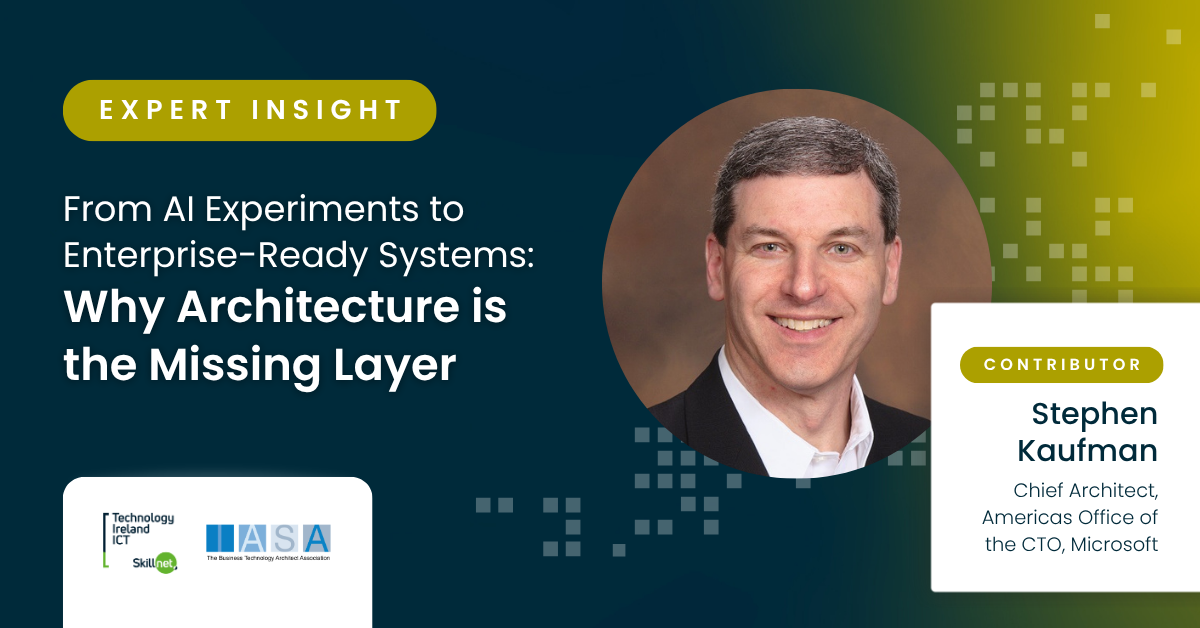
AI pilots can prove what is possible. Turning that potential into a reliable, secure and measurable enterprise capability is a very different challenge. In this deep-dive insights article, Microsoft Chief Architect Stephen Kaufman explains why architecture, data governance and operational discipline increasingly determine whether AI succeeds at scale.
Across industries, organisations have moved rapidly from exploring generative AI to developing copilots, agents and AI-enabled applications. Proofs of concept are relatively easy to create. The harder question is what happens next.
For Stephen Kaufman, Chief Architect in the Americas Office of the CTO at Microsoft, the divide between experimentation and enterprise AI has less to do with the sophistication of the underlying model than many organisations assume:
“In my experience, the difference between a successful AI pilot and an enterprise-grade AI system has very little to do with the model itself.”
Instead, organisations need the architecture, governance, security, data foundations and operating disciplines required to turn an impressive demonstration into something the business can depend on.
Kaufman recently joined Technology Ireland ICT Skillnet and Iasa in Dublin as a guest lecturer on the Iasa AI Architecture Master Class CITA-A. Drawing on his experience working with organisations adopting AI at enterprise scale, he identifies several important shifts now facing architects and senior technology leaders.
Enterprise AI Must Move Beyond Proving What Is Possible
A pilot and a production AI system are designed to answer fundamentally different questions.
A proof of concept asks whether AI can perform a particular task. An enterprise deployment must establish whether it can perform that task repeatedly, securely, cost-effectively and at sufficient quality for the organisation to trust it.
That distinction changes what success looks like.
A pilot might demonstrate a significant reduction in the time required to complete a task. In production, that improvement also needs a business owner, clear KPIs, funding, support processes and accountability for the outcome.
The same principle applies to data. AI systems need access to trusted, governed enterprise knowledge, with clear ownership and appropriate access controls. Security, compliance and auditability also need to be designed into the system from the beginning rather than introduced once the technology is ready to launch.
And because AI systems are probabilistic rather than deterministic, operating them requires a different level of monitoring and evaluation. Quality, cost, safety and business impact all need to remain observable after deployment.
The organisations that scale successfully, Kaufman argues, therefore treat AI as an operational business capability rather than a collection of experiments.
The organisations winning with AI are not the ones running the most pilots. They are the organisations creating repeatable ways to move from an idea into production while maintaining governance, security and control.
A successful pilot and a successful AI system answer very different questions.
Designed to prove possibility and demonstrate that a technology or use case can work.
It must also work at scale, securely, cost-effectively and in a way the business can trust.
The Role of the Architect Is Becoming More Important
The rise of AI has prompted questions about which technology roles will change or diminish. Kaufman sees the role of the architect moving in the opposite direction.
AI introduces uncertainty, autonomous decision-making and operational risks that cannot be addressed through coding alone. Architects increasingly need to design the wider system around the AI model, connecting business outcomes, data, governance and technical capabilities. That begins with understanding where AI genuinely creates value.
Rather than starting with the question of which model to use, architects need to understand the business process involved, where intelligence could improve it and where automation should stop.
The role also extends deeply into information architecture. Copilots, retrieval-augmented generation systems and autonomous agents all depend on decisions about enterprise knowledge, grounding, ownership, access, semantics and governance. Kaufman sees this as an important shift in emphasis:
“The future of AI architecture is increasingly about information architecture. The quality of the enterprise knowledge layer often matters far more than the choice of LLM.”
Agentic AI Changes the Architecture Question
The evolution towards agentic AI pushes the architect’s responsibilities even further. Traditional applications execute predefined instructions. Increasingly autonomous AI systems may be able to select tools, access information, interact with other agents and take actions on behalf of users or organisations.
The architectural question therefore changes from whether an AI system can perform an action to whether it should be allowed to perform it. Architects need to determine the permissions available to agents, the information they can access, where human approval is required, how actions are monitored and how autonomous behaviour can be overridden when necessary.
As organisations eventually operate larger numbers of models, agents, prompts and AI-enabled workflows, individual application architecture will also become only part of the challenge. Reference architectures, reusable patterns, orchestration frameworks, evaluation standards, observability and cost governance will become increasingly important if organisations are to manage AI consistently across the enterprise.
Kaufman describes the shift in striking terms:
In many ways, architects are becoming the designers of digital workforces, not just software systems.
Chief Architect, Americas Office of the CTO, Microsoft
The architect of the AI era, in this view, becomes an orchestrator of business outcomes, data, models, agents, governance and operational controls.
AI Readiness Is Increasingly a Data Readiness Challenge
One of the strongest themes running through Kaufman’s perspective is data.
Organisations frequently approach AI readiness by asking which model they should adopt. He suggests starting somewhere else entirely: what knowledge, data and context will the AI use to make decisions?
Most enterprises already possess considerable amounts of data. The challenge is making that information trustworthy, discoverable, current and usable by both people and AI systems.
That means moving the conversation away from simply collecting and storing information towards building what Kaufman describes as a governed intelligence layer. This becomes particularly significant as organisations adopt AI assistants and agents.
These systems need more than datasets. They need business context, policies, procedures, historical decisions, domain expertise and access to structured and unstructured organisational knowledge. For many enterprise applications, Kaufman therefore recommends focusing on grounding before assuming that customising or fine-tuning the model is the solution. He states that “a world-class model grounded on poor information will still produce poor outcomes.”
Governance is equally important. Rather than viewing governance as a barrier to innovation, Kaufman argues that clear ownership, policies and access rules can allow organisations to move more quickly because teams know the boundaries within which they can operate.
The measure of AI readiness consequently becomes broader than traditional data quality. Organisations need to know their authoritative sources, understand how unstructured content will be managed, trace where AI-generated answers originated and monitor how agents interact with enterprise information. The underlying shift for Kayfman is significant:
“In the analytics era, data was used to answer business questions. In the AI era, data becomes the knowledge foundation from which people and agents take action.”
LLMOps Makes AI a Continuous Operational Discipline
Moving AI into production also changes how technology teams need to think about operations. AI systems are not static. Their behaviour can change as models evolve, prompts are updated, underlying data changes and users interact with the system in new ways.
Evaluation therefore cannot end when an application is deployed.
Teams need to continuously assess grounding quality, accuracy, hallucination, safety, policy compliance and business outcomes. Traditional application monitoring also needs to expand to include model behaviour, prompts, agent actions, latency, token consumption, cost, security events and user feedback.
Lifecycle management then becomes essential.
Models, prompts, agents, policies, evaluation datasets and grounding sources increasingly need the same disciplines organisations already apply to other critical technology assets, including version control, approval processes, rollback capabilities and audit trails. Kaufman draws a useful parallel with an earlier shift in software development: “Just as DevOps brought discipline to application delivery, LLMOps brings discipline to operating AI systems at scale.”
For architects, this means deployment is no longer the finish line. AI systems need to be continuously evaluated, governed and improved throughout their lifecycle.
Architects Need to Build, Not Just Study, AI
What, then, should architects and senior technology professionals prioritise as enterprise AI develops? Kaufman’s advice is straightforward:
“Stop studying AI and start building with it.”
Understanding models remains useful, but architects increasingly need practical experience of how AI, data, governance, security and business processes work together.
That means moving beyond prompt engineering and gaining hands-on experience with copilots, RAG architectures, agents, orchestration frameworks, MCP services and AI-enabled applications. It also means strengthening capability in data architecture, knowledge management and grounding.
Alongside those technical foundations, architects need greater familiarity with evaluation frameworks, LLMOps, observability, FinOps and AI governance. Agentic systems deserve particular attention. Understanding autonomy, identity, orchestration, permissions and human approval boundaries will become increasingly important as AI moves from generating information towards taking action.
But Kaufman ultimately brings the argument back to business value. The strongest architects will not begin with a model and search for somewhere to use it. They will identify where intelligence can improve a business process and then design the architecture needed to deliver that outcome.
If he were prioritising his own development over the coming year, Kaufman would focus on AI and agent architectures, data foundations and grounding, governance and security, LLMOps and observability, and the business process transformation that AI can enable.
Five capabilities architects should prioritise
Architecture Is What Turns AI Potential Into Enterprise Capability
The rapid improvement of AI models will continue to attract attention. But model capability alone does not make an enterprise AI system successful. The harder work sits around it. Organisations need trusted data, appropriate governance, secure architectures, clear business accountability and an operating model capable of continuously evaluating and managing AI systems.
That is also why the role of the architect is expanding. As AI becomes embedded more deeply into organisational systems and begins to take actions as well as generate answers, architects will increasingly determine how intelligence, data, people, processes and controls fit together.
As Kaufman puts it; “The architects who thrive in the AI era will not be the best model experts. They will be the architects who can turn AI into a trusted, governed, measurable business capability that scales across the enterprise.”
Explore the Iasa AI Architecture Master Class CITA-A
Develop practical capability across AI architecture, LLMOps, governance, agentic AI, data readiness and enterprise system design through this intensive programme delivered with Iasa.
Explore the programme