

Date posted: 3rd November 2026
How can organisations and professionals develop the skills needed to turn quantum science into practical applications?
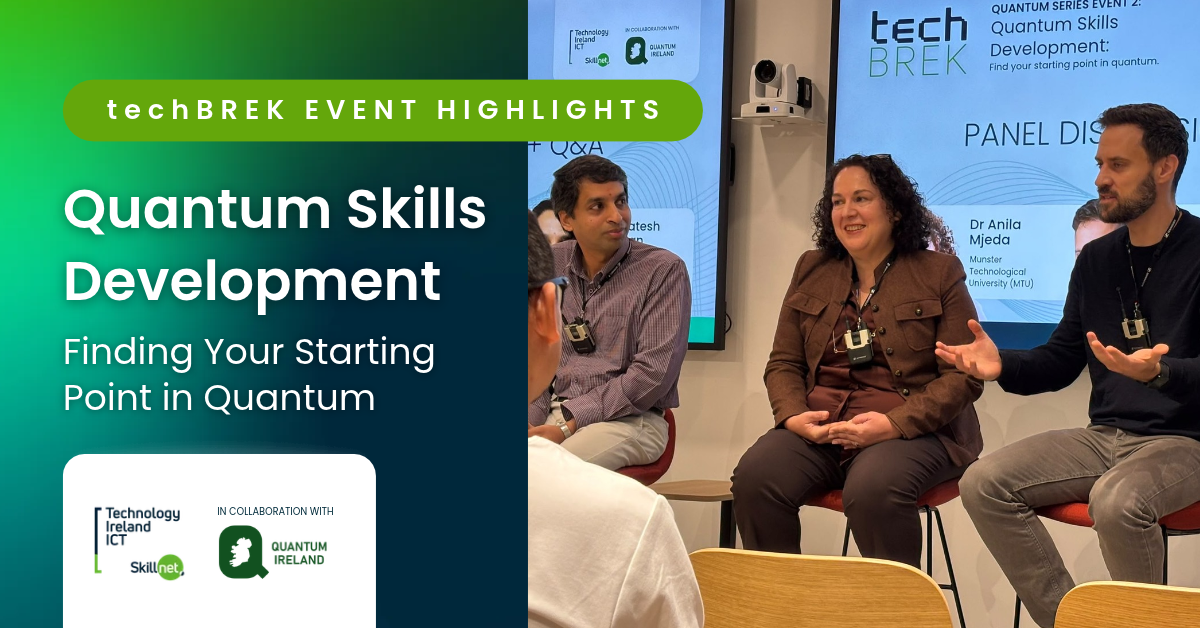
This was the focus of the second instalment of the techBREK Quantum Series, co-hosted by Technology Ireland ICT Skillnet and Quantum Ireland, at the Trinity Innovation Hub on Tuesday, November 3rd.
Following the first event, which explored quantum optimisation and machine learning, this session focused on the education and skills needed to support the growth of Ireland’s quantum technology sector.
Opening remarks from Ciaran Fennessy, Head of AI Delivery, Securities Services at Citi, set the scene for a morning of insights from three speakers representing academia, high-performance computing and European quantum education.
Making Quantum Learning More Accessible
Opening the technical sessions, Dr Anila Mjeda, Lecturer in Cybersecurity at Munster Technological University (MTU), explored how quantum computing education can be made accessible to learners from different backgrounds.
Highlighting the growing demand for quantum skills, Dr Mjeda noted that the industry faces a significant talent gap, with only one qualified candidate for every three quantum job openings. She also highlighted that many industry roles do not require a PhD, underlining the importance of creating more accessible routes into the sector.
Drawing on her experience delivering MTU’s NFQ Level 9 module in Quantum Information Security, she discussed how students from diverse backgrounds in mathematics, physics, software engineering and cybersecurity can develop an understanding of quantum concepts.
Dr Mjeda’s presentation highlighted practical approaches to making complex topics more approachable, including interactive simulations, familiar examples and tools that allow learners to explore quantum protocols and algorithms before moving on to more advanced mathematical concepts.
Exploring Education and Career Pathways
Dr Felix Binder, Assistant Professor in Quantum Science at Trinity College Dublin (TCD) and Course Director of the MSc in Quantum Science and Technology, outlined the growing range of education opportunities for people looking to develop expertise in quantum technologies.
He explored the three main areas of quantum technology: computing, communication and sensing, and introduced Trinity’s one-year, 90-ECTS MSc in Quantum Science and Technology. The programme covers areas including quantum information theory, open quantum systems and physical implementations, alongside industry research projects with organisations such as IBM, Quantinuum, Algorithmiq and Equal1.
Felix also highlighted the European Quantum Academy (EQA), a major European initiative involving more than 70 partner institutions and a €20 million budget. Aligned with the European Competence Framework for Quantum Technologies, the initiative aims to develop structured learning pathways, from introductory knowledge through to advanced expertise, and expand access to quantum education across Europe.
Connecting Quantum Computing with High-Performance Computing
The final presentation came from Dr Venkatesh Kannan, Associate Director (Solutions) at the Irish Centre for High-End Computing (ICHEC), who explored the role of high-performance computing in supporting the development and practical application of quantum technologies.
Venkatesh outlined ICHEC’s involvement in European initiatives, including HPCQS, EuroQHPC and EuroQCS, which are connecting traditional supercomputing infrastructure with quantum processing units. These hybrid environments combine classical and quantum computing capabilities, with potential applications in areas such as climate modelling, earth observation and quantum chemistry.
He also highlighted the importance of developing the skills needed to work with these emerging technologies, outlining ICHEC’s accredited training pathways, delivered in partnership with the University of Galway and supported by grant aid through Technology Ireland ICT Skillnet.
A key offering is Quantum Programming Foundations, a 12-week, NFQ Level 8 accredited micro-credential worth 5 ECTS. Designed for professionals from different technical backgrounds, including systems engineers and software developers, the programme combines foundational quantum knowledge with practical programming skills and interactive learning.
Venkatesh also outlined how these micro-credentials provide flexible learning pathways, allowing participants to build their knowledge and progress towards more advanced qualifications, including the Professional Diploma in Quantum Computing and Programming.
Delivered by the University of Galway in partnership with ICHEC, the 1 year, part-time NFQ Level 9 programme combines quantum theory with practical programming, hands-on projects and experience working with hybrid high-performance computing systems. These initiatives are helping to develop the skills needed to support the adoption of quantum technologies, while connecting learners with wider European education and training opportunities through the European Quantum Academy.
Building Ireland’s Quantum-Ready Workforce
A common theme throughout the morning was that entering the quantum field does not necessarily require an advanced background in physics. As the sector develops, there is a growing need for people with skills spanning software development, cybersecurity, high-performance computing and business leadership.
The speakers explored the different pathways available, from introductory learning and targeted micro-credentials to postgraduate qualifications and specialist research programmes.
Together, their insights reinforced the importance of building a strong skills base to support the growth of quantum technologies. Developing expertise across a range of disciplines will be essential to ensuring Ireland is well positioned to embrace the opportunities ahead.
Continuing the Conversation – Join the next techBREK
The second techBREK Quantum Series event brought together perspectives from academia, research and industry to explore the skills and expertise needed to support Ireland’s growing quantum ecosystem.
The techBREK Quantum Series will continue in 2027, with the next techBREK taking place at the Trinity Innovation Hub on February 17th, focusing on quantum cybersecurity and post-quantum security. The event will bring together experts and industry leaders to explore developments and opportunities in this rapidly evolving area. Click here to sign up to our newsletter to be first to get the announcement when tickets for the next techBREK are available.