
22nd January 2026
Article by Paul Hearns, moderator for techBREK
In business today, the issue of artificial intelligence (AI) cannot be avoided. AI is transforming not just tasks, but the very fabric of work.
It is shifting roles, required skills, and organisational culture. And yet, there is a risk that leaders are being asked to move at a greater pace than their organisations are ready for.
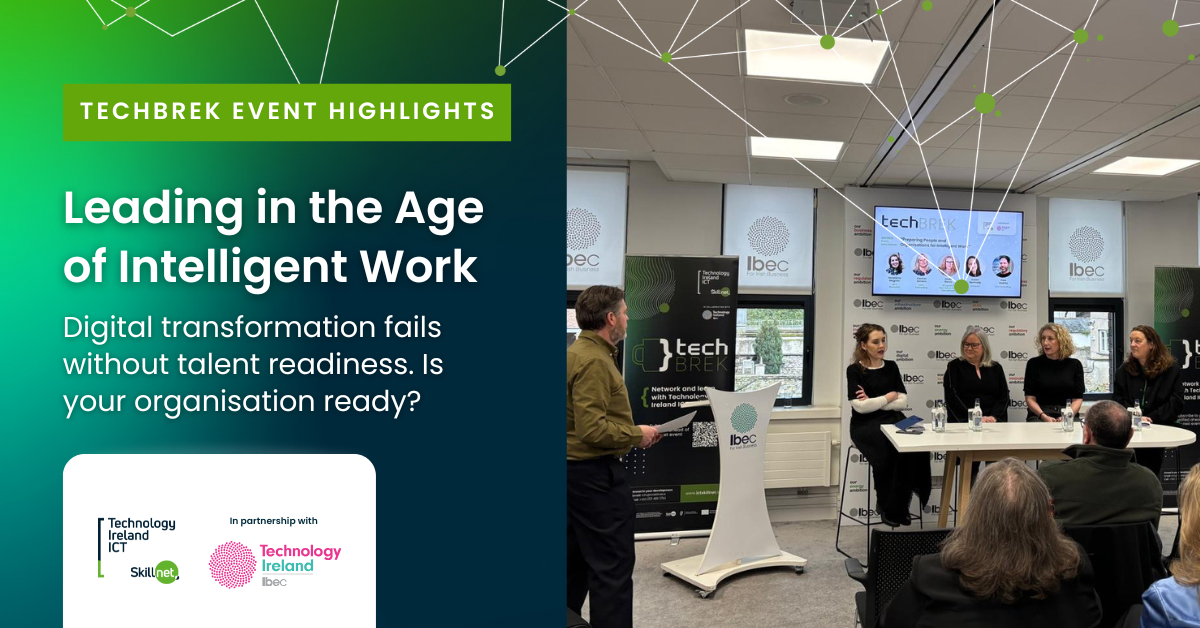
These were the key themes explored by Carmel Somers, chartered work and organisational psychologist, CSCL, at the latest techBREK event from Technology Ireland ICT Skillnet.
Somers illustrated how in this landscape, the most successful organisations will be those that foster human-AI collaboration, invest in higher-order skills, and build cultures of trust and psychological safety.
Those that don’t risk employee and leader burnout, disillusionment, and a loss of capability. Leaders must take ownership of AI’s impact, ensuring robust governance and accountability, Somers argued. Ultimately, focusing on better decisions and stronger judgment will unlock the full potential of AI, enabling organisations to thrive in the era of intelligent work.
AI’s impact on work
The adoption of AI is not just about technology replacing jobs, but about fundamentally changing how work is done, what skills are valued, and what “good” performance looks like.
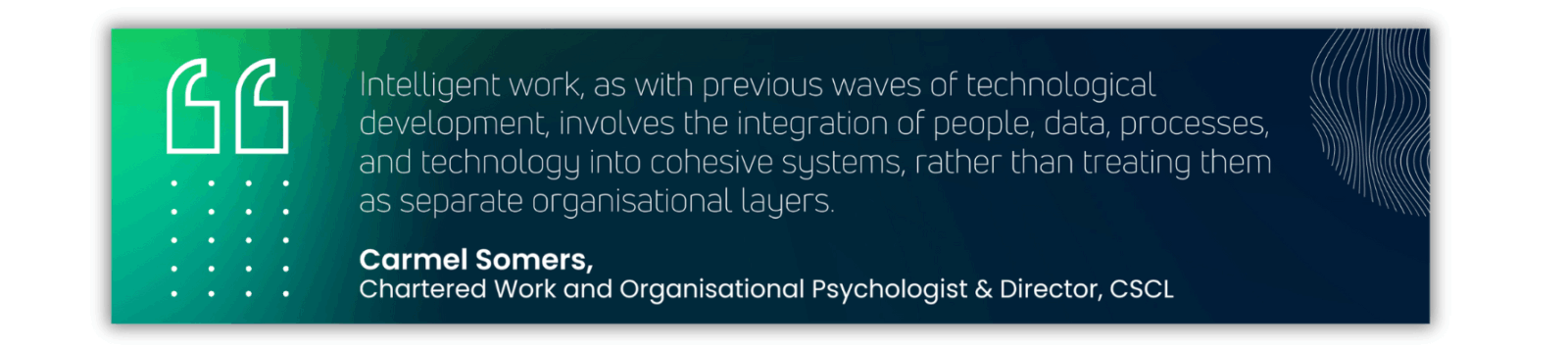
Intelligent work, as with previous waves of technological development, involves the integration of people, data, processes, and technology into cohesive systems, rather than treating them as separate organisational layers, said Somers.
Human-AI collaboration
While AI excels at processing data and identifying patterns, Somers said that humans provide context, judgment, and accountability. As such, the future of work is a partnership between humans and technology.
Automation is a key element too, moving from physical tasks to cognitive domains, supporting decision-making and even influencing organisational strategy in real time.
Somers characterised this as akin to people being moved from primarily operative to managerial roles, supported by all the data gathering and analytics tools they need, to judge and determine the best options to proceed.
Intelligent workflows
Many organisations already use AI-supported workflows, such as decision reviews, case management, continuous learning loops, workforce planning, and dynamic policy updates, and these experiences can be leveraged to make people more comfortable working with AI supports, as opposed to primarily human ones.
However, the shift to intelligent work is subtle but significant — technology now often makes the first move (analysing data and making recommendations), while humans are required to exercise judgment, critical thinking, and ethical awareness. Care must be taken to provide the psychological supports people need to operate predominantly in this mode, as opposed to it being a lesser part of activity.
Operating in this mode requires greater mental energy, and this can take its toll.
Evolving leadership responsibilities
In this environment, leaders must become designers of decision systems, governors of algorithms, and coaches of human judgment, ensuring transparency, alignment with values, and readiness to question automated outputs.
This includes managing new skill requirements. Success in the age of AI demands higher-order skills: interpreting AI outputs, questioning assumptions, detecting bias, knowing when to override or escalate, and moving beyond basic technology training.
Culture and accountability
Organisational culture is crucial in the world of intelligent work. People must feel safe to challenge AI outputs, admit mistakes, and share learning. An atmosphere of psychological safety enables continuous improvement and risk mitigation.
Over all of these measures, clear governance, explicit accountability, and ongoing learning are essential. Leadership cannot delegate responsibility for AI’s impact on governance, risk, service quality, trust, and competitiveness, Somers argued.
Panel views
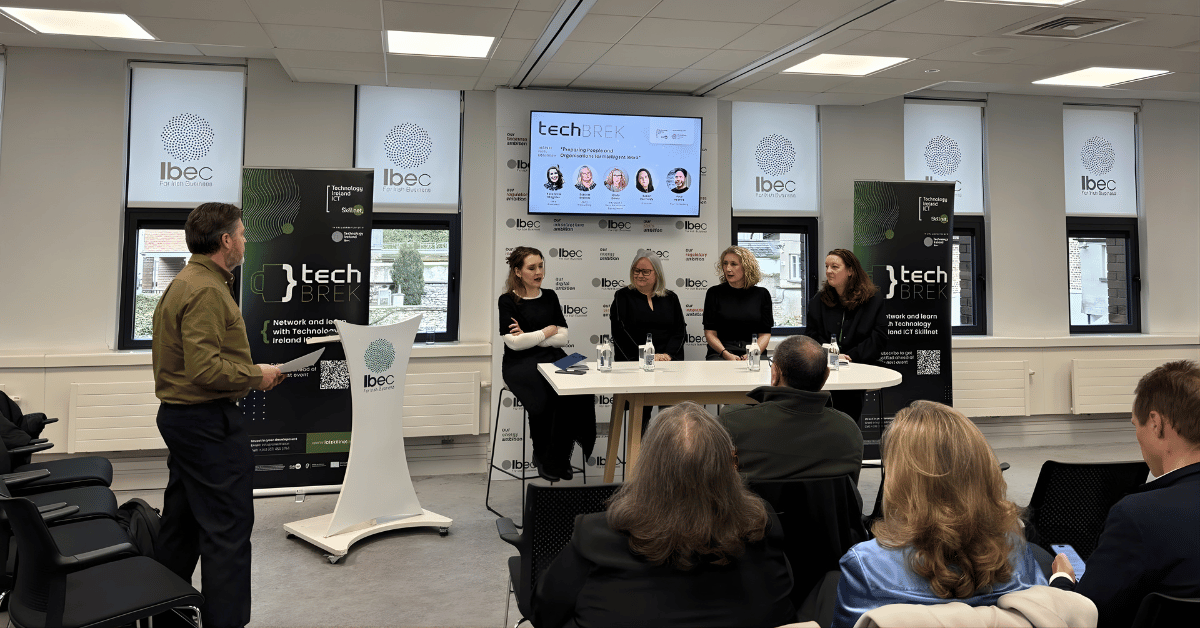
Somers was joined by a panel of experts bringing valuable diverse views to the discussion. Geraldine Magnier, director, Idiro Analytics, and chair of the Small Firms Association, highlighted that small businesses face unique challenges in the world of intelligent work. Rapid adoption of AI tools without adequate policies or shared understanding can lead to risks and organisational dysfunction. Larger organisations tend to have more structured approaches, said Magnier, but change can be slower. Small businesses may experience faster, more disruptive impacts if things go wrong, and require commensurate supports from government and other bodies.
With years of experience in recruiting, and also as a founder and entrepreneur, Linda Davis, co-founder of OXygean and founder of Next Gen, said there is a growing gap between the skills needed for future roles and those currently available, especially in HR and recruitment. Magnier added that transversal skills, such as critical thinking, problem-solving, and adaptability, are increasingly valued over purely technical skills, as they enable employees to navigate change and ambiguity in the new landscape.
This led on to the topic education and digital literacy. Susan Dermody, learning and development manager, Ericsson, highlighted the importance of early education in digital and AI literacy, and successful models were cited from other countries such as Denmark. Industry-led initiatives and government support are both needed to mainstream AI literacy and prepare the next generation for future work, said Dermody.
The panel saw lively engagement from the audience, and one question highlighted the issue of pressure on the board from investors, competitors, and market trends that tended to drive rapid evolution in organisations, often through technology adoption. The panel agreed that companies that fail to adapt risk being outpaced by smaller, more agile competitors that are already leveraging AI for efficiency and value creation, but again warned of the need for proper governance and risk mitigation.
Success and best practices
Amid the concerns and highlighted issues, there are success and best practice emerging.
Ericsson’s Dermody described how newly onboarded graduates had participated in a hackathon that saw them develop tools that are now refined to the point of being included in production environments. The combination of strong guiderails in structured programmes, secure experimentation, and supportive environments allowed the new entrants to perform at their best, and achieve value early in their careers.
Takeaways
Overall, this panel underscored that AI’s impact is not just technological but deeply human and organisational. Success depends on culture, leadership, skills development, and intentionality – not just tool adoption.
The lesson from Somer’s research and the expert view was that organisations must balance rapid change with psychological safety, transversal skills, and inclusive education to thrive in our rapidly the evolving landscape.
Unlock New Opportunities with Technology Ireland ICT Skillnet
If your organisation is exploring tailored, in-company training to help deliver on a digital transformation project, we’d love to hear from you.
Talk to our team about bespoke training for you and your team
