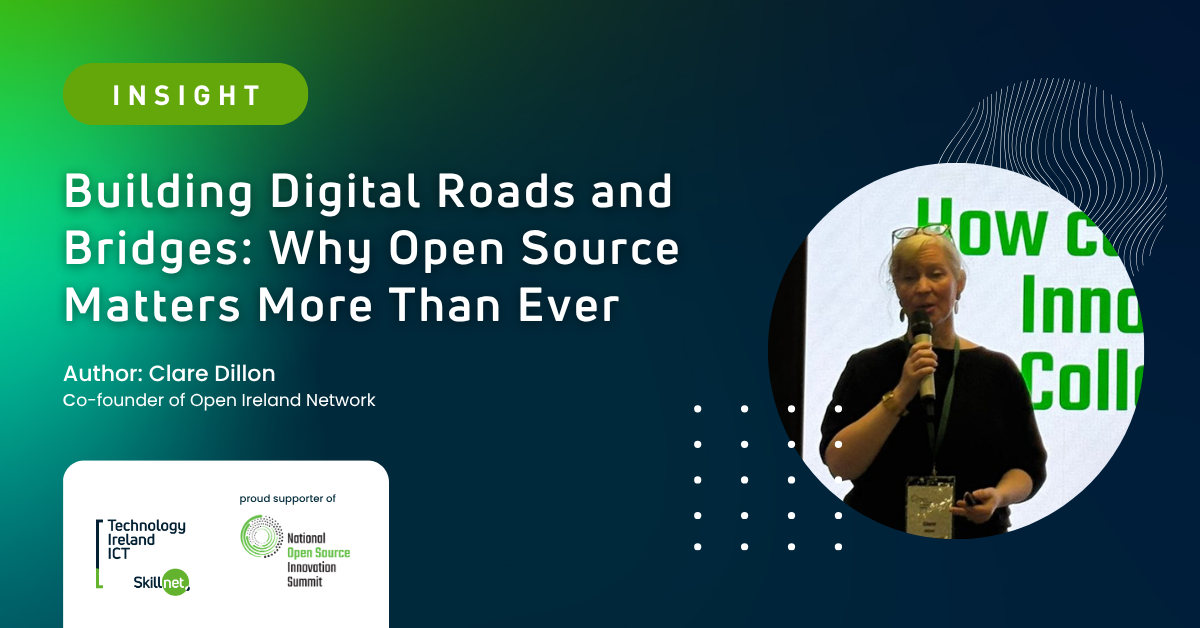
Below is an article from Clare Dillon, co-founder of Open Ireland Network, summarising her opening address at the 2026 National Open Source Innovation Summit in Dublin. The National Open Source Innovation Summit – delivered by Open Ireland Network – brings together a cross-sectoral community to discuss how open source collaboration can accelerate innovation in Ireland and beyond. Technology Ireland ICT Skillnet are proud sponsors of the summit, having also previously funded a research report with Open Source Ireland into open source skills gap in Ireland.
Click here to watch the full opening address on YouTube.
Author: Clare Dillon, co-founder of Open Ireland Network [21st April 2026]
Welcome back! That’s what I got to say for the second year running at the 2026 National Open Source Innovation Summit (NOSIS) and honestly, it was fantastic to see the room full again for our second year holding this event. Open Ireland Network is a community we set up back in 2020 to bring together people across Ireland who care about open source and want to support it at a national level.
The Summit was born out of realising we needed more cross-sectoral conversations if we wanted to achieve what we had set out to do in the Open Ireland Network. Open source is all about collaboration, and we wanted to do that better here in Ireland: bringing together people from multinationals, small indigenous businesses, government, academia, and the broader global community. If you’re wondering why that matters, these are the questions we keep coming back to: How can open source help us innovate quickly? Collaborate better? And how can it specifically impact Ireland’s own innovation strategy?
So many events and activities focus on the technical side of open source – this event focuses on the systems of open source enablement – how we can translate all that amazing open source technology into social and economic impact.
I had my whole speech prepared…
In preparation for the Summit, I was all set to walk the audience through what I thought were some important open source highlights from the past year. And there were some crackers!
The Open Source Economic Report from the Linux Foundation and COSSA showed that commercial open source companies achieve 7x greater valuations at IPO and 14x at M&A than their closed-source peers. Taken with previous research that shows open source contributes an estimated €65–€95 billion to the EU’s GDP, we cannot ignore open source as a priority theme in any strategy or program designed to deliver economic impact.
I was going to talk about the regulatory landscape and the Cyber Resilience Act and how there are special exemptions for open source, which are worth understanding and paying attention to. I was going to point out that news about open source broke out from the technical publications, and actually made it into Ireland’s Business Post in January, with a piece about how Irish firms could benefit from Europe’s €54 billion open source sovereignty plan. That felt like a bit of a moment.
I wanted to highlight the conversations around the importance of open source for Digital Public Infrastructure and impact on the SDGs that were discussed at the United Nations Open Source Week, where the conversation on how we can enable open source at scale is going global in a very real way. And the CURIOSS Gathering event we held the day before NOSIS itself, where 30+ representatives from the global university ecosystem came together to talk about institutionalising open source in academia.
And of course, because you can’t go far without mentioning it, open source AI. The trends are fascinating. Downloads of open source models are surging. China has overtaken the US on Hugging Face. And it’s not just the big foundational models, there’s a move towards smaller, domain-specific models. For example, before Christmas, SAP released an open model on Hugging Face that’s been downloaded 30,000 times a week, with better performance for its use case and 50,000 times less energy consumption than general-purpose LLMs. These are the kinds of developments that deserve a lot more attention, and we had speakers at NOSIS digging deeper into all these themes.
But then… Davos happened.
I watched Mark Carney’s speech at the World Economic Forum, and it really stopped me in my tracks. He talked about a rupture in the world order – not a transition, a rupture. The things we’ve assumed for decades (you know – stability, integration, the institutions that help us work together) are all under threat. Infrastructure (including digital infrastructure) is becoming a strategic asset. And the most natural response is for everyone to turn inward. Build walls. Dig bunkers.
But as Mark Carney pointed out, we know where that path leads. A world of fortresses is a poorer world. A more fragile world. A world with less trust, one that is more miserable to live in, and – in the context of what was there to talk about at NOSIS – a lot less capacity for innovation.
And it made me think about Ireland’s (and open source’s) path in all this…
Ireland as a trusted partner
Ireland is a small, open economy. That’s what we are. Our strength has never come from going it alone – it’s come from being trusted partners in systems larger than ourselves. From connecting. From contributing. From building alongside others.
And when I heard Mark Carney talk about collective investments, shared standards, and complementarities, I thought: he might as well be talking about how we do collaboration in open source.
And that brought me to the question I really wanted to put to the room: What do we want to help build in Ireland to address this new state of world affairs? Fortresses and bunkers? Or roads and bridges? I know which one Ireland is best at. (Well… better at anyway. Let’s not pretend our planning processes are perfect.)
Open source is our digital roads and bridges
Here’s the thing: open source is not a soft, informal endeavour. It is the foundation of our global digital public infrastructure. 96% of proprietary software contains open source, an estimated 70–90% of all code is open source, and it represents a $9 trillion global resource. And just like physical roads and bridges, building digital infrastructure requires planning, maintenance, standards, investment, and cross-discipline collaboration.
When it works best, open source has governance and security protocols. It has decision-making processes. It has funding models. It has norms, roles, and escalation paths. Effective collaborative software development is a discipline, not a vibe. It’s not just a good intention – it’s knowing how to collaborate for impact, and that’s hard.
The challenges aren’t only technical. They’re about taking innovation from the people who build it to the people who adopt it. How do we make collaborations work at scale? Across different domains and disciplines? How do we achieve last-mile impact? How do we maintain and sustain digital public infrastructure rather than just creating it and hoping for the best? Roads and bridges aren’t built on hope.
So how can Ireland contribute?
Look, we’ll probably never top the open source contributor lists by absolute volume of code written or contributions made. But if you look at per capita numbers for Ireland’s number of contributors to open source, we’re up there when compared to other countries. And more importantly, I think there are other things Ireland can bring to the table…. areas in which we have proven, world-leading, capabilities.
Think about the Irish Citizens’ Assembly – a world-leading method for bringing democratic, citizen-led insights into the legislative process, now adopted by countries around the world. Think about how we responded to the marriage equality referendum – the first time in the world same sex marriage was passed by popular vote. Work done by the Yes Campaign and other volunteer-led, civic initiatives helped buck global efforts to usurp our democratic process through misinformation and provided a masterclass in community activism and bridging divides.
Think about our agencies, like IDA Ireland, Enterprise Ireland, and Research Ireland, delivering decades of experience scaling impact beyond our borders, supporting businesses to operate globally and researchers to punch above their weight. Think about the fact that in this country, you’re about one or two degrees of separation from anyone you need in any given room (Six Degrees of Kevin Bacon effect on steroids). And think about our cultural influence in literature, music, film, or even the ability to shut down cities or turn things green across the world for St Patrick’s Day celebrations. Time and again, Ireland has taken something that started small and made it land globally. That’s not luck, it’s a set of unique capabilities. And it’s exactly the kind of capabilities the open source world needs right now.
So, what if we turned all of that potential towards open source enablement? One of the first projects Open Ireland Network worked on was a report on the open source skills gap In Ireland, which was generously funded by Technology Ireland ICT Skillnet. What if we set ourselves the challenge of helping with bridging that skills gap (not just the technical skills, but skills related to governance, business development etc.)? What if we created an environment where the overall system of taking open source technology from code to impact worked seamlessly? Frictionless cross-sector collaboration? Last-mile adoption and building supporting commercial ecosystems? Turning projects into products? Trustworthy open source AI in the EU regulatory context? Building a more collaborative culture in general? If Ireland chose to invest in these areas, we could help build something that has a real impact beyond our borders.
From the fracture, we can build something bigger
I’ll leave you with the line from Carney’s speech that stuck with me most: “From the fracture… we can build something bigger, better, stronger, more just.”
I want to be part of that. I want Ireland to be part of that. I want us all to be part of a global effort to build a better world, leveraging the potential of open source to do it. And if you were at the National Open Source Innovation Summit, you already are part of that same effort. If you didn’t make it to the event.. the door is open. Please connect with us and follow us on LinkedIn.
I want to take this opportunity to once again say a huge thank you to everyone who made the National Open Source Innovation Summit possible: our sponsors, the Open Ireland Network team (reminder: this is no one’s full-time job), the speakers who travelled from abroad to share their expertise, and every single person who showed up to invest their time. We had private sector, public sector, multinationals, indigenous SMEs, local experts, global experts, government representatives, and academics – all in one room, talking about these big system issues together.
That’s exactly the kind of road-and-bridge-building Ireland should be doing.
References
Administrator, B. (2018, July 10). How Digital Threats to Democracy were Tackled During Ireland’s Abortion Referendum—Media@LSE. Media@LSE – Promoting Critical Research into the Vital Role of Media and Communications in Contemporary Society.https://blogs.lse.ac.uk/medialse/2018/07/10/how-digital-threats-to-democracy-were-tackled-during-irelands-abortion-referendum/
Conference Highlights: UN Open Source Week 2025 – An Open Community for the Global Digital Compact – OpenForum Europe. (2026, February 5).https://openforumeurope.org/publications/conference-highlights-un-open-source-week-2025-an-open-community-for-the-global-digital-compact/
Davos 2026: Special address by Mark Carney, PM of Canada | World Economic Forum. (n.d.). Retrieved March 21, 2026, fromhttps://www.weforum.org/stories/2026/01/davos-2026-special-address-by-mark-carney-prime-minister-of-canada/
Helping Irish Business Go Global | Enterprise Ireland. (n.d.). Retrieved March 21, 2026, fromhttps://www.enterprise-ireland.com/en/
Home. (n.d.). Retrieved March 21, 2026, fromhttps://www.idaireland.com/
Long live open source: The movement for a European digital commons. (n.d.). Retrieved March 21, 2026, fromhttps://www.businesspost.ie/tech/how-irish-firms-could-benefit-from-europes-e54bn-open-source-sovereignty-plan/
MajoMartinez. (2026, January 26). SAP RPT?1: Why is it Essential for Predicting Business Outcomes in Today’s and Future Generative AI? SAP Community.https://community.sap.com/t5/technology-blog-posts-by-sap/sap-rpt-1-why-is-it-essential-for-predicting-business-outcomes-in-today-s/ba-p/14314375
Open Ireland Network (Director). (2026, February 25). Clare Dillon – Open Ireland Network—Opening Address [Video recording].https://www.youtube.com/watch?v=6Dp0wHz0ZLQ
Open Source and InnerSource Skills in Ireland – A Call for Action: Technology Ireland ICT Skillnet. (2022, October 11).https://www.skillnetireland.ie/insights/open-source-and-innersource-skills-in-ireland-a-call-for-action-technology-ireland-ict-skillnet1
Open Source Impact Study—OpenForum Europe. (2025, December 8).https://openforumeurope.org/projects-and-initiatives/open-source-impact-study/
Open Source Software: The $9 Trillion Resource Companies Take for Granted | Working Knowledge. (2024, March 22). Harvard Business School.https://www.library.hbs.edu/working-knowledge/open-source-software-the-nine-trillion-resource-companies-take-for-granted
Parker, S. (n.d.). The Path to Marriage Equality In Ireland: https://www.atlanticphilanthropies.org/wp-content/uploads/2018/01/The-Path-to-Marriage-Equality-Ireland.pdf
Research Ireland. (n.d.). Retrieved March 21, 2026, fromhttps://www.researchireland.ie/
State of Open Source on Hugging Face: Spring 2026. (2026, March 19).https://huggingface.co/blog/huggingface/state-of-os-hf-spring-2026
The European Union’s Cyber Resilience Act. (n.d.). Open Regulatory Compliance Working Group. Retrieved March 21, 2026, fromhttps://orcwg.org/cra/
The Irish Citizens’ Assembly. (n.d.). Observatory of Public Sector Innovation. Retrieved March 21, 2026, fromhttps://oecd-opsi.org/innovations/the-irish-citizens-assembly/
The State of Commercial Open Source 2025. (n.d.). Retrieved March 21, 2026, from https://www.linuxfoundation.org/research/2025-state-of-commercial-open-source