
Published: 11th March 2026
Modern AI development often assumes that higher complexity equals better results. For Sian O’Briain, DevOps Manager and Product Owner at Merative, the future of the industry depends on proving that assumption wrong.
Through her capstone project on the MSc in DevOps, Sian investigated how “Green AI” can reduce the environmental cost of software delivery without sacrificing performance.
In the fast-paced world of DevOps, speed and reliability are usually the primary metrics of success. However, as AI becomes a daily tool in the software development lifecycle, a new, critical variable has entered the equation: sustainability.
Sian O’Briain, who manages a team of eight responsible for the CI/CD workflows of the Cúram by Merative platform, saw an opportunity to bridge her passion for DevOps with the growing need for environmental accountability.
TLDR; The rising carbon footprint of AI means “bigger isn’t always better”. By prioritizing model selection and “Green AI” principles, DevOps practitioners can achieve superior predictive accuracy with 300x less energy consumption, proving that sustainability and high performance are not mutually exclusive.
The Industry Problem: The Rising Carbon Footprint of AI
The hardware, transport, electricity, and water required to train and run machine learning models are growing at a rate that threatens global climate goals. Despite this, many in the industry operate under the “bigger is better” assumption, often choosing sophisticated, resource-heavy models even when the performance gain is negligible.
“I liked thinking about how Green AI could not only be better for the planet but also make DevOps practices more efficient and cost-effective,” Sian explains. Her research focused specifically on the training phase of machine learning, where strategic decisions can have the most significant impact on a company’s carbon footprint.
From Theory to Practice: Testing the Efficiency of Complexity
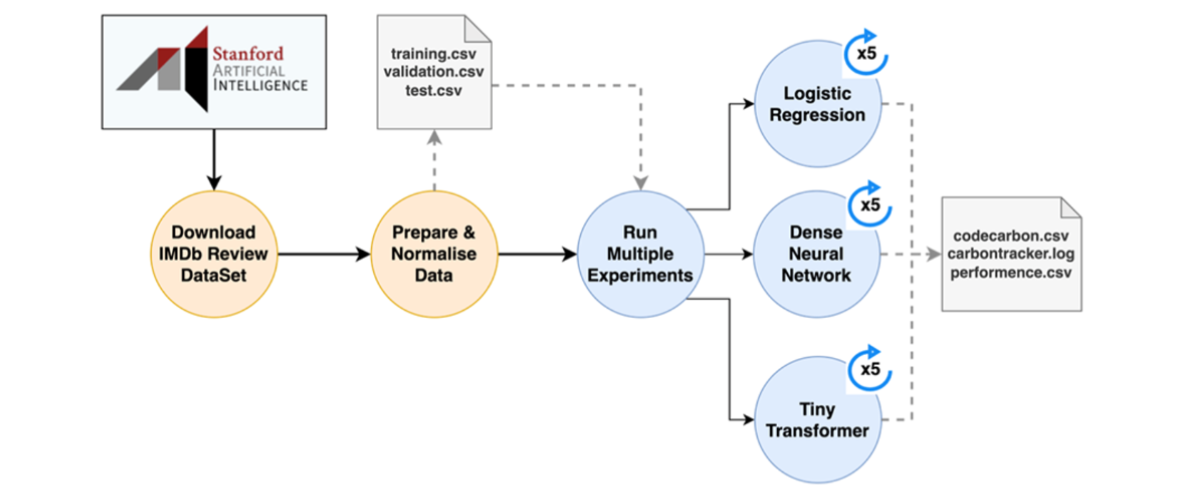
To test the relationship between model complexity and environmental cost, Sian built an automated pipeline to train three distinct models on a sentiment analysis task using 50,000 film reviews. The models represented a spectrum of complexity:
- Logistic Regression (Simple)
- Dense Neural Network (Medium)
- Tiny Transformer (Advanced)
Using industry-standard carbon tracking tools like CodeCarbon and CarbonTracker, Sian measured the energy consumption and CO2e emissions for each.
The Results: A 300x Disparity
The findings were a wake-up call for advocates of model complexity.
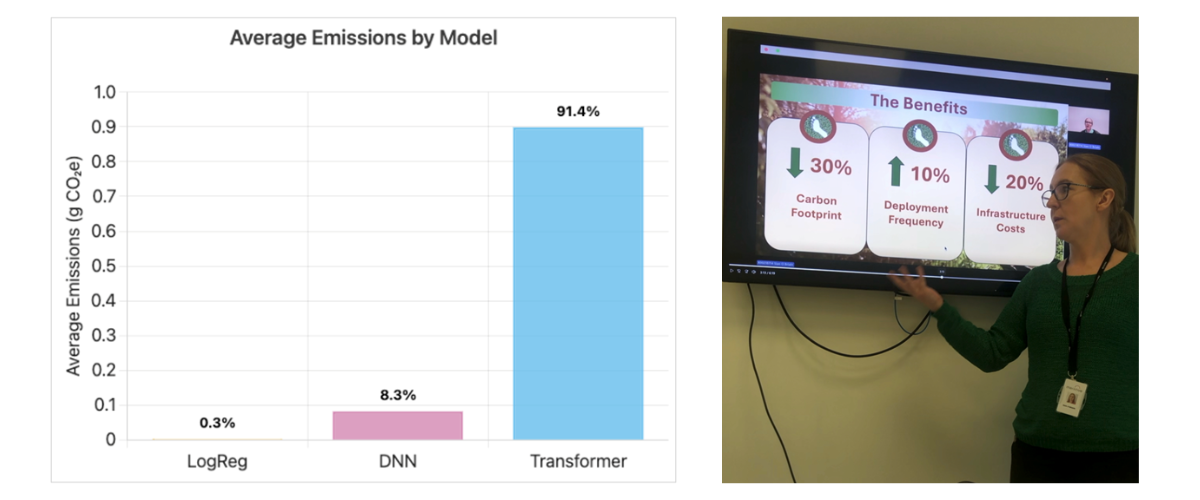
- Performance: The simplest model, Logistic Regression, achieved the highest predictive performance with over 90% accuracy.
- Sustainability: The Transformer model emitted approximately 300 times more CO2e than the Logistic Regression model for the same task.
- Efficiency: Increasing complexity offered no improvement in predictive performance for this dataset, yet dramatically increased energy consumption due to longer training times.

Why Model Selection is a Strategic DevOps Mandate
Sian’s research highlights that model choice is not just a technical preference; it is a strategic business decision. “Strategic operational decisions will not only reduce a company’s carbon footprint but will also be more cost-efficient without compromising outcomes or value,” she notes.
She identifies several practical outcomes for companies looking to adopt “Green DevOps”:
- Right-Sizing Automation: Apply simpler, targeted automation rather than complex, resource-heavy solutions.
- Geographic Flexibility: Source compute power from regions with lower carbon-intensity grids.
- Operational Scheduling: Run training workloads at times of lower demand when renewable energy is more available.
A Career Transformed: Beyond the Technical Lab
Sian’s journey to this research began years ago with a flexible Arts degree at Maynooth University, where she mixed Computer Science with Physics and Maths. Her move into the MSc in DevOps was driven by a desire to overcome “imposter syndrome” and gain a well-rounded education that balanced technical labs with business technology strategy.
“The course and the project have changed how I approach and plan projects in general,” Sian says. She now utilises structured methods like SWOT analysis, risk assessment, and ROI to ensure that DevOps solutions align with both business goals and sustainability targets.
Building a Sustainable Future at Merative
The impact of Sian’s Master’s degree is already being felt at Merative. Sian is currently establishing a focus group dedicated to sustainable IT initiatives to drive green initiatives across the workplace. “It is important to take a holistic view when incorporating AI into our workflows,” Sian concludes. “What may look like increased compute usage in a CI/CD pipeline can actually reduce overall effort, repetition, and energy use across the wider development lifecycle”.
About Sian O’Briain
Sian O’Briain is a DevOps Manager and Product Owner at Merative, where she works on the Cúram by Merative platform that supports governments in delivering social welfare and benefits programmes. She manages a team responsible for the CI/CD workflows used to build and release the product and has built her career across software configuration management, DevOps, Agile delivery, and engineering leadership. She completed her capstone project as part of the MSc in DevOps with TU Dublin.
Bridge the digital divide, and lead on innovation.
As organisations increasingly adopt a DevOps culture, the demand for technologists with a combination of software development and IT operations skills has reached a critical point.
Bridge the digital divide, and lead on innovation.
