
25th March 2026
Completing a Master’s in Artificial Intelligence while working full-time is not a casual commitment. It demands consistency, focus, and a willingness to stay with difficult material long enough for it to become usable skill.
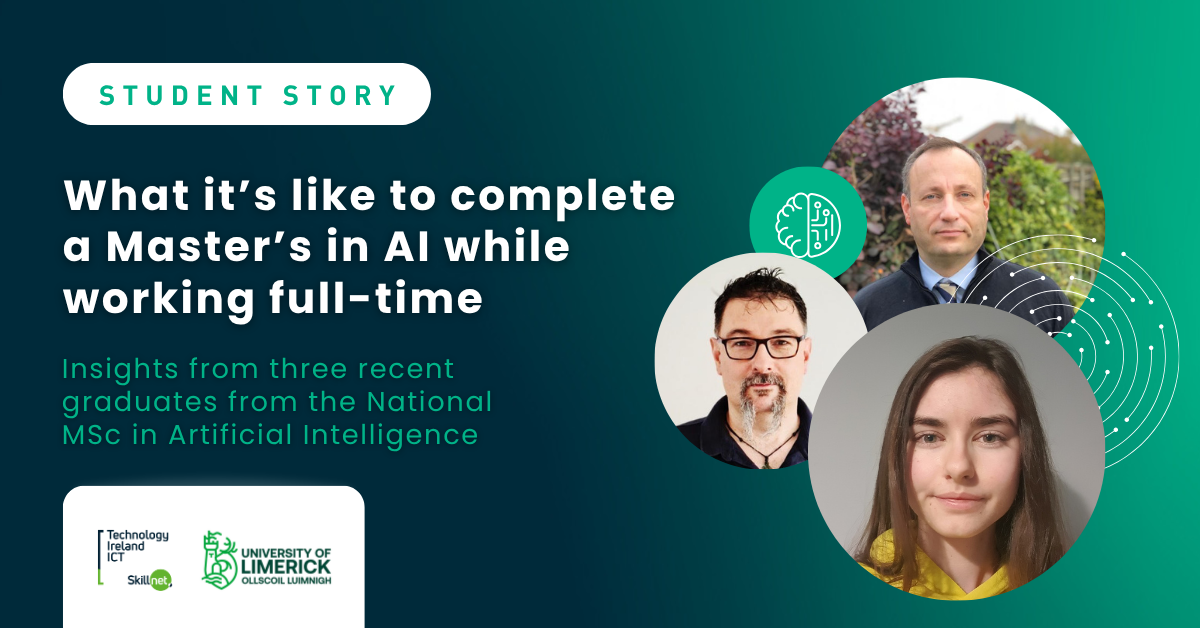
To capture what that experience is really like, we spoke with three graduates who have just completed the two-year National MSc in Artificial Intelligence, delivered online by the University of Limerick in partnership with Technology Ireland ICT Skillnet.
Three graduates, three starting points, one shared goal: real AI capability
One of the most useful ways to understand a Master’s programme is to look at who it serves well.
This cohort includes professionals with very different roles and levels of experience, which reflects the reality of AI in industry. It is not owned by one job title. It is a capability that touches engineering, software delivery, and technical leadership.
- Basil AlMukhtar is a Digital Design Engineer at onsemi, designing and verifying digital functional blocks inside modern chips for power management applications. He progressed into digital design after more than a decade in application engineering and power systems architecture.
- Jason Coleman is a Consulting CTO and Research/Analyst at Neuralstorm, working at the intersection of AI, computer vision, spatial computing, 3D graphics, and secure systems engineering. He focuses on turning advanced research into robust, scalable, real-world production systems.
- Wiktoria Ziaja is a Software Engineer at Dell Technologies, who progressed from intern to Software Engineer 2 early in her career. Her perspective reflects the mindset of professionals building depth quickly while continuing to progress at work.
The decision point: why commit to a two year programme while working full-time
For prospective learners, the first differentiator is rarely the module list. It is whether the programme fits the reality of work and life for a professional. Across all three conversations, one theme was consistent: the decision was driven by the need for depth, not a desire to follow hype.
Wiktoria’s decision started with long-standing interest, not logistics. “AI and computing was always a big interest for me,” she says, and after completing her undergrad she was already thinking about how to continue building depth. Her original plan was to pause for a few years to save, then take a year out of work to study but what changed was finding a Master’s route that made serious study compatible with career momentum.
For Basil, the motivation was direct and practical. “I wanted to ride the wave of AI and did not want to be left behind,” he says, describing the MSc as “the next leap into the future with new career opportunities.”
Jason’s motivation came from the way AI was becoming pervasive across his work, from medical imaging and synthetic data generation to deep learning-based computer vision. He could already use off-the-shelf models, but wanted “a deeper understanding of how modern AI systems are built, evaluated, and scaled.”
The Master’s in AI experience
The reality of completing a two-year Master’s while working full-time is not just time pressure. It is the mental context switching between professional delivery and academic learning, especially when content becomes mathematically or programmatically demanding.
What stood out in the graduates’ reflections is that the structure made the work achievable, even when it was stretching.
Basil highlights a feature that matters when you are learning outside your core comfort zone. “The MSc in AI programme offers collaboration between students to tackle weekly assignments,” he says, and he found that very useful especially when assignments involved programming challenges. He also points out that the MSc assumes no AI background and “gradually builds student knowledge from the basics of AI theory to advanced tools like Reinforced Learning, LLM (Large Language Models) and Computer Vision.”
Wiktoria’s description reinforces the same core point in a different way. What worked for her was that the course structure prevented overwhelm, because it was organised into manageable blocks that made ongoing progress realistic alongside work.
Jason describes the programme as one that “balanced theory with practical application,” and deliberately designed for working professionals in a fully remote format.
What changes when AI stops being a black box
A second differentiator for professionals comparing programmes is whether the course changes how you reason about AI, not just what you know about it.
Wiktoria describes a shift that many professionals will recognise. “AI was like a black box of mysteries at first for me,” she says, but after the first year of the Master’s in Ai she realised “it’s not complicated as it seems and the more complex aspects just build on the simple structure block.”
Jason’s reflection focused on the habits that separate credible AI work from attractive demonstrations. He returned repeatedly to evaluation discipline, repeatability, and systems thinking, which is the mindset you need when models move beyond notebooks and into real organisations.
Basil describes the change in terms of method selection and performance. “Gaining AI knowledge gave me the skill to understand its strengths and weaknesses to correctly assign an AI method to a target problem with optimal settings,” he says, “thus saving development time for an optimal level of performance.”
The practical value: What employers gain immediately
Unfortunately, training can’t just be about long-term career impact. There needs to be immediate capability, because that is what employers and professionals need to justify the investment when the time and effort are still recent.
Wiktoria describes how the programme strengthened her ability to contribute to planning and reduce future rework. “I can help during the planning process to explain different models, their structures, how and why they work with the data we have,” she says, and that this can help mitigate problems in the future and reduce trial-and-error.
Basil’s immediate workplace value shows up as a concrete applied example. “After graduating I demonstrated at onsemi the advantage of convolutional neural networks to correctly classify test results reliably with fraction of time compared to manually going through 100’s of generated graphical test data,” he says, describing a new approach that adds value in a real engineering environment.
Jason frames the value in terms of decision-making quality and credibility. “The immediate value is disciplined, credible decision-making around AI,” he says. He highlights that graduates can design and evaluate experiments properly, avoid common pitfalls such as overfitting or data leakage, and improve communication about what AI can and cannot realistically deliver. He also points to the ability to challenge weak assumptions and ask the right questions of vendors, helping organisations move beyond simply consuming AI tools.
A programme that fits different professional profiles
A final differentiator is whether a programme supports learners with different starting points, because modern AI work increasingly requires collaboration across roles.
Some of the learners on the latest class to graduate the National MSc in Ai come from deep engineering contexts, where verification and robustness are central. Some come from leadership and systems delivery contexts, where evaluation and production readiness matter most. Some are earlier career professionals, where the goal is to build foundations quickly while continuing to progress at work.
That range is a signal in itself. It suggests the programme is designed for working professionals with different starting points, and that it is capable of building shared language and capability across roles.
The value is not simply that you learned about AI. The value is that you learned to reason about it, evaluate it, and apply it responsibly in real organisational contexts.
Closing: A fresh view worth paying attention to
If you are considering a Master’s in AI, you will find no shortage of programmes promising relevance and impact. The more useful test is whether a programme develops the habits that make AI work credible in practice, and whether it is designed to be completed by working professionals without losing momentum.
Fresh from graduation, these three perspectives point to a consistent conclusion: the value is not just the knowledge. It is the ability to evaluate, communicate, and apply AI more responsibly and more effectively, straight back into the workplace.
Learn more about the National MSc in Artificial Intelligence
